
Keep Your Power

Keep Your Power

  Gregg Braden, talk excerpt The dark night of the soul is when the bulldozer of change comes through your life and levels everything; then it backs up and makes another run so your ego, your identity, is left with nothing. You may loose all your physical resources, your relationships, your trust in others, but you will be left with your innermost self. And you’ll realize you are actually okay. Then life will get much better after all of that.

The better we know ourselves, the less we fear change in the world. We fear change because we have hinged our wellbeing on the world around us. When deep spiritual awakening leads us, we begin to realize that we’re okay no matter what’s happening out there. We begin to become more self-sufficient, rather than relying on external systems for our wellbeing; whether it’s growing your own food or having a backup power system. We take responsibility for the things that are important to us, rather than giving our power away.

You alone are responsible for yourself. Your friends and the world of activity will not answer for your deeds when the final reckoning comes. – Paramahansa Yogananda

It’s only after you’ve lost everything that you’re free to do anything. – Tyler Durden

You have a treasure within you that is infinitely greater than anything the world can offer. – Eckhart Tolle

A Balanced Life

A Balanced Life

  Sri Chinmoy, adapted    To be actively calm and calmly active is the essence of a balanced life. We need to be active, but undertake activity with inner peace. As well as working and achieving things, we should not ignore the importance of looking after ourselves and paying attention to our inner life. Here’s some suggestions for being actively calm and calmly active.

1. One Thing at A Time – Whatever you do, you should give it your full attention and focus. With only one thing to do and think about, it is easier for your limited mind to cope. With several things on your mind, you flit from one problem to another and can become overwhelmed at how difficult life seems.

By doing several things at once, you won’t get more done; you will just feel busier and more important. Try to do only one thing at a time and see the difference it makes. Start off with your most important task, breaking it into smaller parts; gradually tick off the things you need to do.

2. Take Time for RelaxationIt’s very easy to feel that life is too busy to spend 20 minutes cultivating inner peace. However, the success of your outer activity depends on your inner state. If the mind is confused and brimming with conflicting thoughts, outer activity will be hard work and you’ll be victim to your own insecurities. If you can clear the mind and achieve an inner state of peace, you will be able to work much more effectively. Time set aside for yourself will not reduce potential, it will give you increased productivity.

Every Day Counts

Every Day Counts

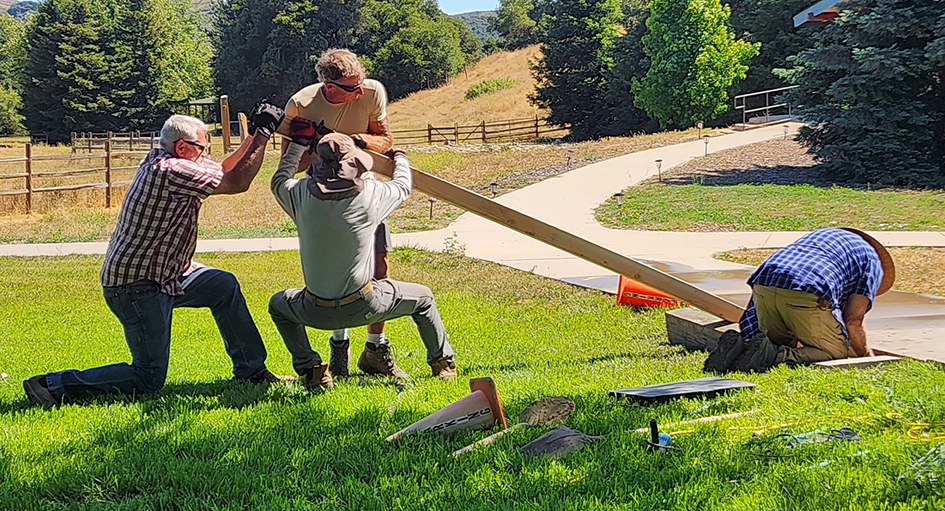
• by Norman Paulsen, Sunburst Founder  [photo: Sunburst work crew  •  God’s power responds almost immediately when it is for the benefit of all beings that we pray. We can see miracles and the presence of Spirit’s power working.

When we pray for selfish gain, sometimes God will fulfill strong desires of our hearts just to get those desires out of the way; those desires exist between us and God. But, for the most part, God does not acknowledge our selfish prayers. We might wonder why—it’s because we are not fulfilling Cosmic law.

When we are more concerned with helping those around us, instead of ourselves, we can see God’s power working. Spirit watches the humble servant and says, “I have to help them because they’re so busy helping everyone else.”

I have seen over and over again how God miraculously takes care of the humble servant. This is the one who sets their own desires aside and entertains only the desire to serve God. God loves that person so much, and loves divine communion with that soul. God’s living presence becomes so strong in that person that it fulfills every desire they have set aside.

They may say, “Lord, I don’t need that anymore, or “I gave that up…it really doesn’t matter anymore.”

God responds, “That’s alright, just take it anyway. You can give it away if you want to.” These are things that we see God doing for us. Humble servants have seen miraculous power at work to build things for the betterment of all humankind.

You may think that what you are doing every day is insignificant and means nothing, but as you practice selfless service, you can make your work an active meditation. Walking a spiritual path, you will receive God’s renewable creative life force through every cell of your body. Allow Spirit to work through you each day and watch your actions become instruments of creation, resurrection, regeneration and healing for yourself and all those around you.

“Live each present moment fully and the future will take care of itself.” – Paramahansa Yogananda

Editor’s Note: Norm is proud of the selfless workers—men and women—who keep Sunburst going every day.


The Wise Woman’s Stone

The Wise Woman’s Stone

• An Ancient Tale, as recounted by Dawn King • A wise woman who was traveling in the high mountains of Kashmir found a special stone in a stream, as she crossed. Holding it up to the light, she could see it was a precious sapphire crystal, highly valued for its beautiful blue color. She thanked God, and tucked it into her pack. 


The next day she encountered another traveler. This was a man ill prepared for his journey. He appeared tired and hungry. The compassionate woman opened her pack to share her food.

After they ate, she stowed her cook pot away and the man caught a glimpse of the glittering precious crystal. “What is that?” he asked. 


“Oh, it’s nothing important,” she replied.


“Then give it to me to examine,” he demanded. She did so without hesitation while looking deep into his eyes. 

Soon, with a self-satisfied smile, the traveler tucked the crystal into his pocket. “It’s valuable to me,” he said and quickly left, rejoicing in his good fortune. He knew the stone was worth enough to give him security for a lifetime. 


The woman thanked God that she and the stone were of help to a stranger. She was also thankful that after their meal, her load was lightened, and she no longer had to guard and care for the valuable sapphire.


A few days later as the wise woman was continuing her lengthy journey, she found the same man coming toward her up the trail. He looked confused. Approaching, he called out to her. “As I was leaving you several days ago, I heard you praying aloud to God, just like I was, giving thanks for good fortune. But for you, this was after I’d taken what must have been your most valuable physical possession.” 

The woman shrugged, and smiled.

“I came back to apologize to you, and to learn how you gained your truly most valuable possessions: compassion and peace of mind. Since I left you, I’ve had none of these, although I now have money.”

The man then spent his days accompanying the woman on her further trips, as he learned of the virtue, inner peace, and contentment we all need to value most. These are the hidden gems within us that we must polish and treasure in this life time.

NOTE: About Ayurvedic planets and gemstones: Saturn is the Law-of-Karma planet that brings us to our senses (usually by hard knocks). Its gemstone is blue sapphire.

Winning With Contentment

Winning With Contentment

Winning With Contentment

• by Valerie Joy King •

Recently I got the subject of “Practicing Contentment” as the topic I was to cover during my meditation talk. It caused me to contemplate deeply: What is contentment? How should we practice it? and why would you want to practice contentment?

Contentment has me thinking of a big mama cow sitting in the middle of a lush, green field chewing her cud with not a care in the world. Or it’s a baby who’s just finished nursing and they’re sleeping, with that blissful little smile on their face—utterly content. But as we grow older, contentment begins to have deeper meaning.

Contentment is a translation of a Sanskrit word “santosha,” and it may not have exactly the same meaning. Santosha comes from two different words: “sam,” meaning absolute, and “tosha,” meaning acceptance. To me this doesn’t mean absolute acceptance of some outer circumstance; it’s absolute contentment and peace within you. People may think of contentment as a sort of apathy, or “Oh, whatever. I’m not going to do anything.” But that’s not the spiritual meaning of it.

Meditating on it, I realized that if I see something in the outer world—a circumstance, relationship or something that needs work—I don’t just leave it be. It means I find and connect with that place inside of true peace and then deal with it in a way that is going to be helpful, and really move that situation forward and improve it.

A chance to practice came during a recent council meeting at a nearby city, where some people were very angry and upset, while misunderstanding a current situation. In the midst of the complaining and negative comments, I realized I had to practice gratitude, compassion, and connect with the bliss consciousness deep inside my spirit. Then I could listen to others and be able to see the good that these people were trying to do, even if it was misguided.

The city mayor wanted a positive outcome, and was looking at both sides. He happened to be a man, probably about 70, with white hair and beard. He was so kind and compassionate, I thought he appeared like Santa Claus. And what happened because of his energy was that everyone felt pretty good at the end, even though they didn’t get what they wanted. That was a really nice experience of understanding what contentment means—not that we simply accept the circumstances, but we feel at peace and move on from there.

How can you practice contentment from the inside out, and the outside in? We can grab a hold of the reins of our mind and senses through being conscious of our actions, our feelings and our thoughts. We can hold them, and work through them. Even if we’re feeling frustration, anxiety, worry, fear, or anger, we can work through that without having to throw it out on somebody else, making the whole situation worse. We have compassion for ourselves and others, by taking responsibility for ourselves. “Here I am. I may not be in control of the circumstances, but I’m always in control of how I respond and resolve a situation within myself.”

As long as we’re breathing in and out, we’re going to be riding on this sea of life, which is like riding a wave. Some of them are bigger than others; some of them knock us over. Some of them are fun to ride. So, it’s up to us to make the effort each day to find that place of peace. It’s funny that it takes effort to find that peace, but it does because there’s so much swirling around us all the time, so many circumstances. You have to make the effort.

Rooted in the Earth, Reaching for Spirit

Rooted in the Earth, Reaching for Spirit

• by Diane Hope    My Journey into Organic Gardening    I didn’t expect to find myself in the garden. I thought I was looking for something practical—healthy food, maybe a hobby to clear my mind. But what I found in the soil was something much deeper. I found a reconnection with life, a slower rhythm, and an unexpected doorway into Spirit.

It started simply enough. A few pots on a balcony, some basil and tomatoes. I read about organic gardening—how it avoids synthetic fertilizers and pesticides; how it builds the soil rather than depleting it. At first, I was focused on the technical side: composting, companion planting, making DIY sprays with garlic and soap to deter aphids. It felt like a puzzle, and I liked solving it.

But somewhere in the routine of watering, weeding, and waiting, something shifted. I stopped rushing. I started listening. Each morning, I would visit the garden with a cup of tea. The same patch of earth, the same plants—but every day, something was different. A new bud. A visiting bee. The subtle movement of vines seeking the sun.

Organic gardening isn’t just about what you don’t use. It’s about how you relate to the land. It demands attention, presence, and respect. You can’t force a seed to sprout. You can’t command the weather. You learn patience. You learn humility. You learn that you’re not in control, and somehow, that becomes comforting.

The deeper I got, the more I realized this was a spiritual practice. Not in the religious sense, but in the way it turned me back to the sacredness of life. There’s a kind of prayer in pulling weeds—if you approach it with intention. There’s meditation in turning compost, watching decay turn into life. I began to feel that everything in the garden is a cycle: death feeding life, letting go and making room for growth. It mirrored my inner world.

I used to think spirituality had to be found in stillness, in silence. But I’ve found just as much peace in the rhythm of digging, sowing, and tending. The garden doesn’t ask for perfection—it just asks that you show up, pay attention, and care. The earth is forgiving. It invites you to try again.

There’s also a deep trust in organic gardening. You trust the earth will provide what the plant needs. You trust the beneficial bugs will balance out the pests. You trust that even in failure—when the squash gets mildew or the tomatoes split—you’ve still gained something. Knowledge. Insight. Presence.

Now, I don’t just garden to grow food; I garden to remember who I am. To ground myself in something real and tangible. To feel awe again—for the miracle of a seed becoming a sprout, for the mystery of roots that know where to go.

Organic gardening has taught me that Spirit isn’t something separate from the physical world—it’s infused in it. In every leaf, every worm, every breath of wind. When I’m in the garden, I feel it. I belong to the earth, and the earth belongs to something larger.

And that, for me, is sacred practice and scared prayer.


1-805-736-6528
Contact Us